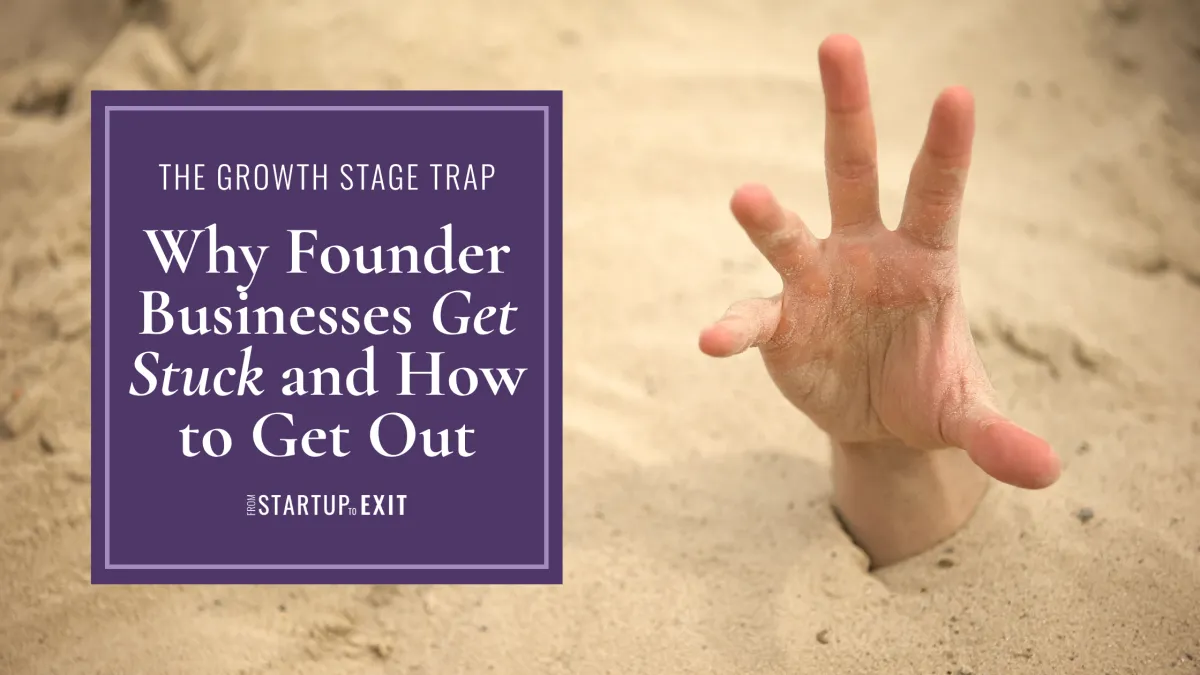
The Growth Stage Trap: Why Founder Businesses Get Stuck and How to Get Out
The Growth stage is the most common place for founder businesses to plateau.
Not because the founders are not capable. Not because the business is not working. Because the Growth stage has a structural trap built into it. And it is very easy to fall into.
Understanding the trap is the first step to getting out of it.
What Is the Growth Stage?
At Growth, you have proof. The offer works. Clients are getting results. Revenue is coming in consistently. The commercial engine is running.
The problem is that the engine is running on founder fuel. Every key relationship, every delivery decision, every new client acquisition runs through you personally. You are the bottleneck.
The right move at Growth is to extract yourself from that bottleneck: to go deeper on the proven offer, build your first recurring revenue, and start creating infrastructure that lets the business run without your manual involvement in every transaction.
Why Founders Get Stuck
Doing that work requires time. Focused, concentrated time on the business rather than in it.
A Growth-stage founder rarely has that time. Every available hour goes into delivery to existing clients, generating new enquiries, and running the operational tasks that keep the business functioning. The infrastructure work stays on the list.
The ceiling does not move because the ceiling is the founder. And the founder is too busy working in the business to do the work that would lift it.
This is not a time management problem. It is a structural problem.
Three Moves That Get You Out
The first move is a recurring revenue floor. Even small recurring revenue changes the felt experience of running the business. Twenty subscribers at £49 per month is £980 before you sell anything else that month. It is a floor. And a floor changes everything about how the next launch, the next client acquisition, the next quiet week feels.
The second move is one proven offer running from a funnel. Not requiring a new launch every time you need revenue from it. The offer exists, the funnel nurtures leads, the checkout converts. You focus on delivery. The acquisition runs independently.
The third move is one documented process. Not everything. One. Written clearly enough that someone other than you could follow it. This is the start of extracting yourself from being the only person who can operate the business.
These moves are not dramatic. They are structural. And structure is what moves the ceiling.
Where to Start
The free stage assessment gives you a precise diagnosis of your current stage and the clearest priorities for the next ninety days.
Three minutes. Start there.