The Four Stages Of Business Explained (And Why You Do Not Have to Reach All Of Them)
Most founders are applying the wrong strategy for their stage of business.
Not because the strategy is bad. Because it was designed for a different stage. And stage mismatch is one of the most expensive mistakes a founder can make.
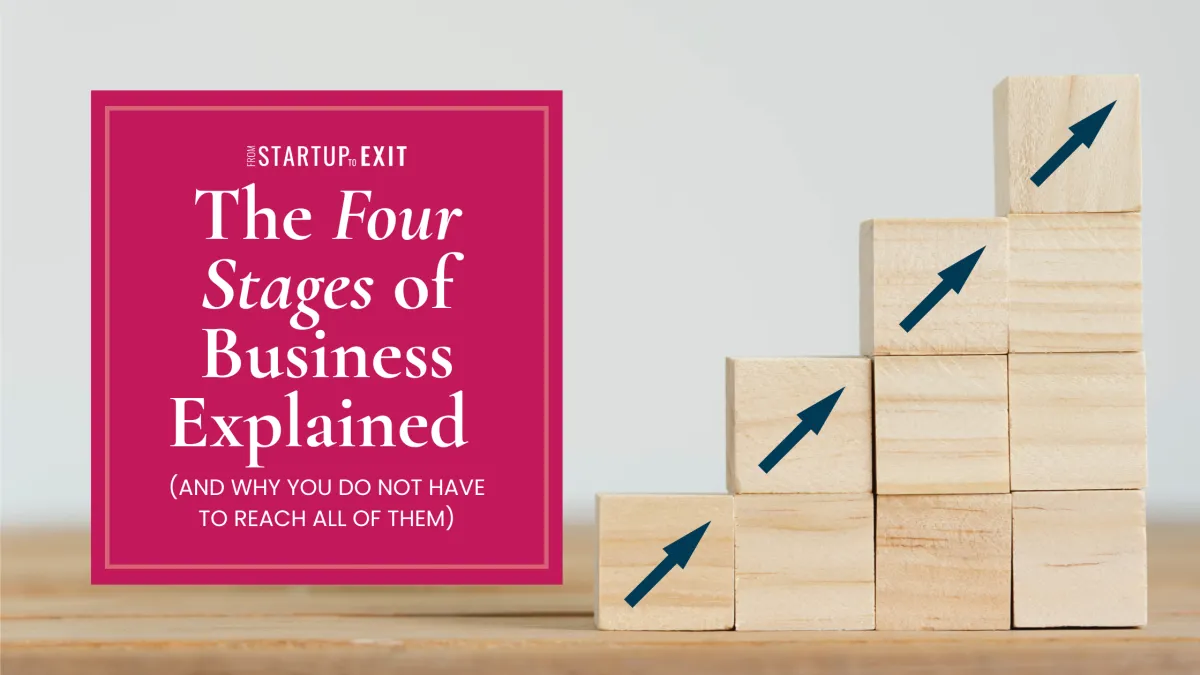
There are four stages of business: Startup, Growth, Scale, and Exit. Each has different priorities, different right moves, and different mistakes that will cost you money if you make them.
Understanding which stage you are actually in, not where you aspire to be, is the starting point for everything.
What is the Startup Stage?
At Startup, your only job is proof.
One offer that works. Real clients who pay real money and get documented results. That is the entire mission.
The most common mistake at Startup is building sophistication before you have proof. A polished brand, a multi-page website, a full product suite, complex automations. Before you have a single case study that demonstrates the commercial engine works.
Sophistication at Startup is procrastination with a budget attached. Proof is the only currency.
What is the Growth Stage?
At Growth, you have proof. The offer works, clients are getting results, revenue is coming in. The problem is that you are the bottleneck.
Every key relationship runs through you. Every delivery decision requires your input. The business cannot function at full capacity without your constant presence.
The right move at Growth is to go deeper on what already works, not to add new things. Build your first recurring revenue stream. Start extracting yourself from delivery on your most proven offer. Stop adding complexity.
The most common mistake at Growth is adding new offers and new audiences to solve a conversion problem that is actually a depth problem. More complexity does not fix a bottleneck. It makes it worse.
What is the Scale Stage?
At Scale, the commercial engine works and you are no longer manually operating every component of it.
Now the job is systems and capacity. Documentation, delegation, offer ladder architecture, a team that can deliver without you in every room.
The most common mistake at Scale is over-controlling. The founder who cannot let go of delivery is their own bottleneck. The work at Scale is operational and identity work simultaneously.
What is the Exit Stage?
At Exit, the business needs to demonstrate that it can generate revenue and function operationally without you as the critical dependency.
Buyers pay for future income streams. The lower the risk that stream gets disrupted, the higher the multiple. Risk is reduced by recurring revenue, documented processes, a capable team, and a client base that is not entirely dependent on your personal relationships.
The most common mistake at Exit is staying in delivery too long. A business that cannot survive without its founder is not a sellable business. It is a job with a company registered to it.
Do You Have to Go to Exit?
No. And this matters.
Exit is one of four stages. It is not the mandatory destination for every founder. A well-optimised Growth business, one that funds a great life, requires reasonable hours, and runs without constant founder heroics, is a completely legitimate goal.
It’s also important to understand that exit does not always mean to sell. Sometimes you can build your profitable business so well, it can pretty much run without you. Systems and automations do the heavy lifting, a small team handles delivery. An operator (Fractional Integrator like me) can run it for you - so you get to live your life and keep living on the profits. And it can go like this for years - sure you need to show up occasionally, your DNA is the driver of forward momentum, your ideas are the life source for the team, content may need your face, but those days are limited through the year. Events and networking will likely still be important so you can retain your key person of influence status but they become much more enjoyable when you no longer need to ensure the ROI is there every time.
The map is a diagnostic, not a prescription. What it gives you is clarity about where you are so you can apply the right strategy for your stage.
How to Find Your Stage
The free stage assessment takes three minutes and ten questions. It gives you a precise diagnosis of your current stage and clear priorities for the next ninety days.
Start there. The right strategy becomes straightforward once you know the stage.